
Share James S Smiley's obituary with others.
Invite friends and family to read the obituary and add memories.
Stay updated
We'll notify you when service details or new memories are added.
You're now following this obituary
We'll email you when there are updates.
Select your format and elements to print

IN LOVING MEMORY OF James S Smiley
James S
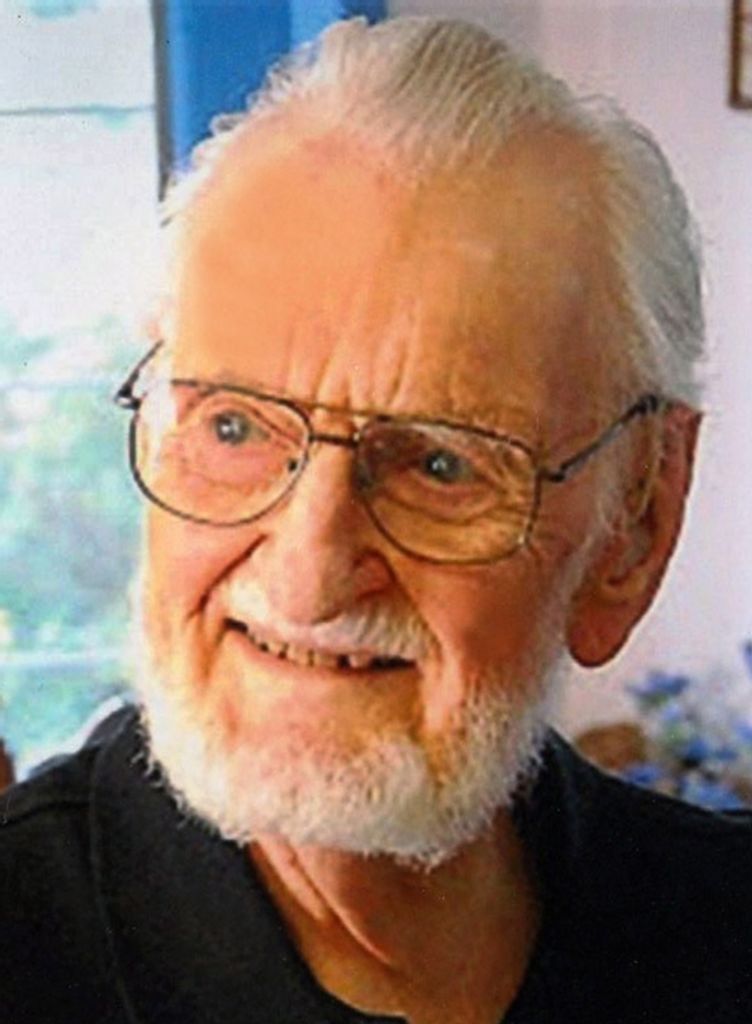
Smiley
Apr 8, 1918 — Mar 20, 2015
James S Smiley's Obituary
Jim Smiley (James Spalding Smiley) died on the 20th of March, two weeks from what would
have been his 97th birthday. Friends, family, all those who knew and loved him, will find it fitting
that he died on the first day of Spring because his life was in a sense a series of beginnings, the
first when he was born in April of 1918 in Cleveland, Ohio to Edwin Smiley and Maude
Spalding.
As a teenager Jim was involved in a head-on collision which left him seriously injured, but
he survived to begin a new life in Manhattan where he studied to be an artist. There he married
Elizabeth Bledsoe. He is survived by two children from that marriage, Fran Krug of Hayward,
California, and Michael Smiley (Bonnie) of Milwaukie, Oregon, and two grandchildren, Erin
Michele and Marc Awbrey.
After studying art in New York, Jim spent 20 years in the printing business before he
decided it was time to begin his real careerteaching. He enrolled as a graduate student in Art
Education at Florida State University. While completing course work for his Master's Degree, he
accepted an offer from FSU's prestigious University School to teach art in the Elementary
grades. In the years he spent at the school he was known as "the pied piper" because of the
many young students who followed him around.
As if graduate school and full time teaching weren't enough, Jim continued painting
in watercolor, a medium he preferred since his art school days. His scenes from an island off
the Florida's panhandle became one of the most successful exhibitions in the history of the
Le Moynes Art Foundation in Tallahassee. Every painting was sold.
One would think this would have encouraged Jim to forget teaching and work full time at
his art. Instead, he left Tallahassee to become a full time instructor at Daytona Beach
Community (now Daytona State) College where he remained until his retirement. "I enjoyed
the classroom," he once explained. "Teaching is its own art." As proof, many of his students
became successful artists.
When he quit teaching, Jim devoted his creative energies to painting, including
experiments with more abstract and non-representational images, in a sense another rebirth
because, as he put it, "I want to show people a new way of seeing the world."
And he did, not just as an artist but as a man. His life demonstrated to all who knew him that
getting old was a state of mind, life itself an art, that age should not stop anyone from having
new experiences, from grasping new passions. Nor should it dull one's sense of humor,
especially about life's little ironies, something Jim demonstrated until the end. Such qualities
explain why all those who knew Jim never thought of him as old, even when his health declined.
Jim wanted to be cremated after his death, and insisted on a private and informal farewell
no sermons, no contributions. His wishes will be granted because, as his friends and family also
knew, he could be charmingly stubborn.
The ashes will be scattered in the backyard of the home where so many of his birthdays were
celebrated. The ashes will no doubt help the Spring flowers to flourish, just as the love for him,
and the memories of him, will flourish. It will be another beginning.
have been his 97th birthday. Friends, family, all those who knew and loved him, will find it fitting
that he died on the first day of Spring because his life was in a sense a series of beginnings, the
first when he was born in April of 1918 in Cleveland, Ohio to Edwin Smiley and Maude
Spalding.
As a teenager Jim was involved in a head-on collision which left him seriously injured, but
he survived to begin a new life in Manhattan where he studied to be an artist. There he married
Elizabeth Bledsoe. He is survived by two children from that marriage, Fran Krug of Hayward,
California, and Michael Smiley (Bonnie) of Milwaukie, Oregon, and two grandchildren, Erin
Michele and Marc Awbrey.
After studying art in New York, Jim spent 20 years in the printing business before he
decided it was time to begin his real careerteaching. He enrolled as a graduate student in Art
Education at Florida State University. While completing course work for his Master's Degree, he
accepted an offer from FSU's prestigious University School to teach art in the Elementary
grades. In the years he spent at the school he was known as "the pied piper" because of the
many young students who followed him around.
As if graduate school and full time teaching weren't enough, Jim continued painting
in watercolor, a medium he preferred since his art school days. His scenes from an island off
the Florida's panhandle became one of the most successful exhibitions in the history of the
Le Moynes Art Foundation in Tallahassee. Every painting was sold.
One would think this would have encouraged Jim to forget teaching and work full time at
his art. Instead, he left Tallahassee to become a full time instructor at Daytona Beach
Community (now Daytona State) College where he remained until his retirement. "I enjoyed
the classroom," he once explained. "Teaching is its own art." As proof, many of his students
became successful artists.
When he quit teaching, Jim devoted his creative energies to painting, including
experiments with more abstract and non-representational images, in a sense another rebirth
because, as he put it, "I want to show people a new way of seeing the world."
And he did, not just as an artist but as a man. His life demonstrated to all who knew him that
getting old was a state of mind, life itself an art, that age should not stop anyone from having
new experiences, from grasping new passions. Nor should it dull one's sense of humor,
especially about life's little ironies, something Jim demonstrated until the end. Such qualities
explain why all those who knew Jim never thought of him as old, even when his health declined.
Jim wanted to be cremated after his death, and insisted on a private and informal farewell
no sermons, no contributions. His wishes will be granted because, as his friends and family also
knew, he could be charmingly stubborn.
The ashes will be scattered in the backyard of the home where so many of his birthdays were
celebrated. The ashes will no doubt help the Spring flowers to flourish, just as the love for him,
and the memories of him, will flourish. It will be another beginning.
To send flowers or plant a memorial tree in memory, please visit our flower store.
James S Smiley's Guestbook
Visits: 6
This site is protected by reCAPTCHA and the
Google Privacy Policy and Terms of Service apply.
Service map data © OpenStreetMap contributors